
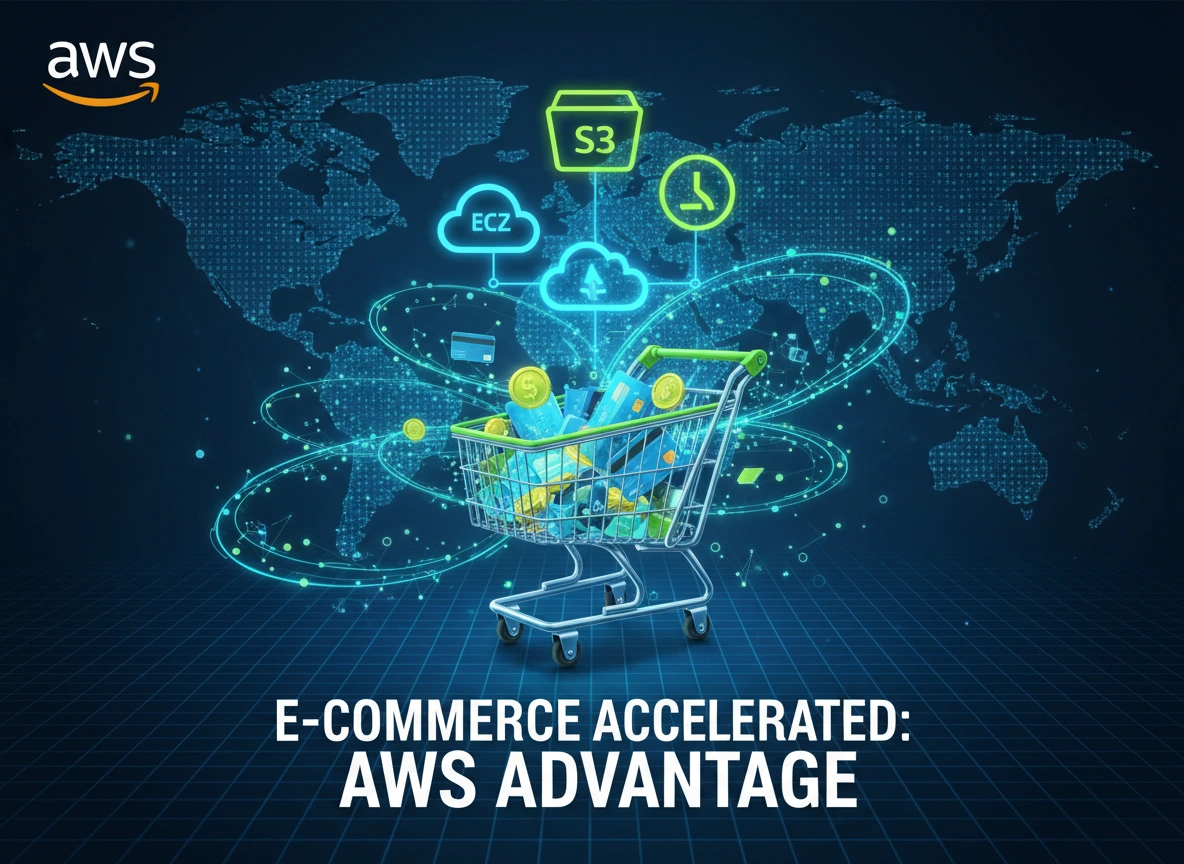
Running an online store is no longer just about having a website and some inventory. It is about speed, reliability, and the ability to handle sudden surges in traffic without crashing. When your platform goes down, you lose money every second. That is the harsh reality of digital retail.
This is where cloud infrastructure becomes the backbone of your operation. Specifically, Amazon Web Services (AWS) has emerged as the gold standard for e-commerce hosting and management. While starting from scratch is an option, many businesses find that securing established or pre-configured AWS accounts can accelerate their deployment.
This article explores why investing in Buy Aws Accounts is a strategic move for e-commerce businesses. We will look at how the cloud giant powers scalability, ensures robust security, and helps you manage costs effectively.
The Cloud Computing Revolution in Retail
Cloud computing has fundamentally shifted how retailers operate. In the past, you needed physical servers in a climate-controlled room to run a large online store. You had to pay for the hardware upfront, hire IT staff to maintain it, and pray that a power outage didn’t wipe out your Black Friday sales.
Today, the cloud handles that heavy lifting. You rent computing power over the internet. This shift allows e-commerce owners to focus on what they do best: selling products. Among the various cloud providers, AWS holds the largest market share for a reason. It was built by Amazon.com, the world’s most successful e-commerce entity. They built the tools they needed to survive, and now they sell those tools to you.
Scalability: Handling the Black Friday Rush
The nightmare scenario for any e-commerce manager is a site crash during a major sale. If your marketing campaign goes viral and thousands of customers flood your site at once, traditional hosting often buckles under the pressure.
AWS solves this with unparalleled scalability.
Elastic Compute Cloud (EC2)
AWS offers a service called EC2 (Elastic Compute Cloud). Think of EC2 as a fleet of virtual computers at your disposal. When traffic is low—perhaps at 3 AM on a Tuesday—you only pay for a small amount of computing power.
However, when traffic spikes, AWS “Auto Scaling” kicks in. It automatically adds more virtual servers to handle the load. Once the rush subsides, it scales back down. This elasticity means your website stays fast and responsive whether you have 50 visitors or 50,000. For an e-commerce business, this reliability directly translates to retained revenue and customer trust.
Cost-Efficiency: Paying Only For What You Use
One of the most compelling reasons to move to AWS is the “Pay-as-you-go” pricing model. Traditional hosting often requires you to pay for peak capacity year-round. You are essentially paying for a 50-seat bus when you only have two passengers most of the time.
AWS allows you to treat infrastructure like a utility bill—you pay for the electricity you consume.
Reducing Capital Expenditure
By buying into the AWS ecosystem, you eliminate the need for significant capital expenditure (CapEx) on hardware. There are no servers to buy, no hard drives to replace, and no cooling systems to maintain. Instead, these costs shift to operational expenditure (OpEx), which is often easier to manage and scale with your business growth.
Furthermore, AWS offers tools like “AWS Cost Explorer” and “AWS Budgets.” These allow you to track your spending in real-time and set alerts if you are approaching your budget limits. This level of financial visibility is crucial for e-commerce businesses operating on thin margins.
Security: Protecting Customer Data
Trust is the currency of the internet. If customers do not trust you with their credit card information, they will not buy from you. E-commerce businesses are prime targets for cyberattacks, including DDoS attacks and data breaches.
AWS provides a level of security that is difficult for a standalone business to replicate on its own.
Shared Responsibility Model
AWS operates on a “Shared Responsibility Model.” AWS is responsible for the security of the cloud—protecting the physical data centers and the hardware. You are responsible for security in the cloud—encrypting your data and managing user access.
However, AWS gives you powerful tools to handle your side of the bargain:
- AWS Shield: This provides managed Distributed Denial of Service (DDoS) protection. It safeguards your applications from attacks that try to overwhelm your site with fake traffic.
- IAM (Identity and Access Management): This allows you to control exactly who has access to what within your AWS environment. You can ensure that a marketing intern doesn’t accidentally have access to the root database.
- Compliance: AWS supports more security standards and compliance certifications than any other offering, including PCI-DSS, which is essential for handling credit card data.
Global Reach: Selling to the World
If your server is in New York, a customer in Tokyo will experience a slower website due to latency. In e-commerce, speed kills—or rather, a lack of speed kills conversion rates. Studies consistently show that even a one-second delay in page load time can result in a 7% reduction in conversions.
AWS has a massive global infrastructure. They operate “Availability Zones” and “Regions” all over the world.
Content Delivery with Amazon CloudFront
You can use Amazon CloudFront, a Content Delivery Network (CDN), to cache your content closer to your users. When a customer in London visits your site, they load images and scripts from a server in London, not from your main server in the US. This ensures a lightning-fast shopping experience regardless of where your customer is located.
Buying an AWS account gives you immediate access to this global network, allowing a local business to perform like a multinational corporation.
Essential AWS Services for E-commerce
When you acquire an AWS account, you aren’t just buying server space; you are gaining access to a toolbox of over 200 services. Here are three that are critical for online retail:
1. Amazon S3 (Simple Storage Service)
E-commerce sites are heavy on media. You have thousands of high-resolution product images, videos, and downloadable guides. Amazon S3 provides highly durable and scalable storage for these assets. It is designed to deliver 99.999999999% durability. This means the likelihood of losing a file is infinitesimally small.
2. Amazon RDS (Relational Database Service)
Your product catalog, customer orders, and inventory data need to live in a database. Managing a database manually is complex and risky. Amazon RDS automates time-consuming administration tasks such as hardware provisioning, database setup, patching, and backups. It allows you to resize the database capacity effortlessly as your inventory grows.
3. AWS Personalize
This is a game-changer for marketing. AWS Personalize uses the same machine learning technology used by Amazon.com to create real-time personalized recommendations for your customers. It can suggest “products you might like” based on browsing history, significantly increasing average order value.
Why AWS Stands Out Among Competitors
While Microsoft Azure and Google Cloud Platform are strong competitors, AWS maintains a distinct edge for retail. The primary reason is maturity. AWS has been in the game longer than anyone else. They have a larger ecosystem of partners, more extensive documentation, and a wider array of third-party tools that integrate seamlessly.
Furthermore, the “Amazon” DNA is undeniable. Many of the features within AWS were born out of the specific needs of Amazon’s own retail operations. When you use AWS, you are leveraging the same infrastructure that powers the world’s biggest store during Prime Day.
Conclusion
In the competitive landscape of online retail, your technical infrastructure is a strategic asset. It determines how fast you can move, how safe your customers feel, and how profitable your operations can be.
Buying an AWS account—and properly configuring it—is a smart move for any e-commerce business aiming for longevity. It transforms IT from a bottleneck into a growth enabler. You gain the ability to scale instantly, secure sensitive data with enterprise-grade protection, and reach customers globally with minimal latency.
Don’t let legacy infrastructure hold your business back. Explore how AWS can modernize your e-commerce operations today. Whether you are launching a new brand or scaling an existing empire, the cloud is ready for you.